
Knee Highs
Compression knee highs are intended for the prevention and treatment of leg swelling and symptoms of venous insufficiency in the calf segment. The class is chosen on a specialist’s advice or by how you feel.
-
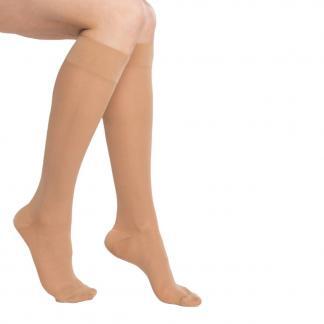
Lauma AD205 Medical Compression Knee-high Socks with Closed Toe, Compression Class I
19,10 € Select options This product has multiple variants. The options may be chosen on the product page -
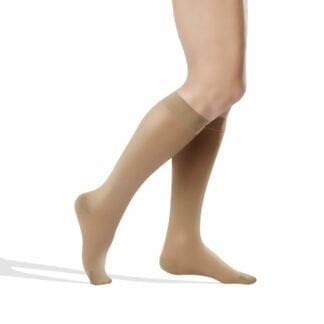
Tonus Elast 0401 Medical Compression Knee-high Socks with Closed Toe
19,90 € Select options This product has multiple variants. The options may be chosen on the product page -
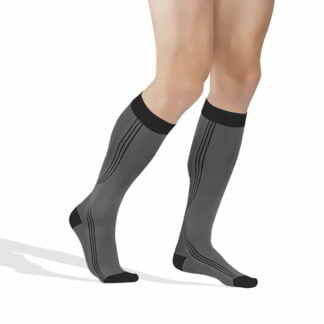
Tonus Elast 0401 Active Medical Compression Knee-high Socks with Closed Toe, Compression Class 1
22,60 € Select options This product has multiple variants. The options may be chosen on the product page
Knee highs — how to choose
Compression knee highs are intended for the prevention and treatment of leg swelling and symptoms of venous insufficiency when the problem is in the calf segment. When choosing, you need to determine the compression class on a specialist’s advice or by how you feel; the basis is the pressure the knee high exerts at the ankle.
Compression classes
The main parameter of a compression garment is its compression class — the pressure the garment exerts at the ankle.
- Preventive garments (up to 18 mmHg) — during pregnancy; for at-risk occupations (prolonged standing or sitting, lifting weights); for people who are overweight or have a hereditary predisposition to vein disease. They can be bought without restriction.
- Compression class I (18–21 mmHg) — for “tired legs” syndrome; for early-stage venous insufficiency (numbness, “pins and needles”, swollen and aching ankles and calves towards evening, calf cramps); for preventing deep-vein thrombosis and swelling in the postnatal period; for preventing vein thrombosis in at-risk groups; for reducing swelling in varicose veins.
- Compression class II (23–32 mmHg) — for treating varicose veins without trophic changes; for treating acute thrombophlebitis and deep-vein thrombosis; for treating and preventing post-thrombotic syndrome; before and after sclerotherapy and phlebectomy; for post-traumatic swelling. Class II garments are recommended for use after consulting a doctor.
Quality and support
All garments are CE-marked medical devices. If the problem also affects the thigh, consider tights. Our specialists will help with the size and class.
Frequently asked questions
Is a prescription needed for class II compression garments?
Before buying class II compression garments (CCL 2), a doctor’s recommendation is advised. No prescription or proof is required for purchase, but note that class II is therapeutic and, if used incorrectly, can harm your health.
How do I choose the right size?
The size of a compression garment is determined by measuring the leg circumferences at the indicated points (for example, at the ankle and calf). The right size is essential for the garment to provide correct graduated pressure. The size chart for each model is given in the product description.
Do compression stockings differ for men and women?
Usually not — the models are most often the same for both men and women. What matters is the right size and compression class, not gender. The right size is determined by measuring the leg at the indicated points.